Ingredient Cost Breakdown: How to Cost a Dish Accurately
Accurate ingredient costing requires more than adding up grocery prices. Learn how to calculate as-purchased vs. edible portion cost, yield percentage, and build precise recipe cost cards.
Most recipe cost errors happen before a single dish is cooked. They happen when someone confuses the cost of what they bought with the cost of what they actually use. These two numbers are often very different.
If you buy a 5-lb bag of potatoes for $4.50 and your recipe uses 2 lbs of peeled potatoes, you don't enter $4.50 into your recipe cost card. You enter the cost of 2 lbs of usable potato, which is calculated differently than just dividing $4.50 by 5.
This is the difference between as-purchased (AP) cost and edible portion (EP) cost, and getting it right is the foundation of accurate recipe costing.
As-Purchased Cost vs. Edible Portion Cost
As-purchased cost (AP): The price you pay per unit (pound, each, case) when you receive the delivery.
Edible portion cost (EP): The cost of the usable ingredient after trimming, peeling, butchering, or cooking. This is always higher than AP cost because you lose product during processing.
The formula:
EP Cost per Unit = AP Cost per Unit ÷ Yield %
Where Yield % = (Usable weight ÷ Total purchased weight) × 100
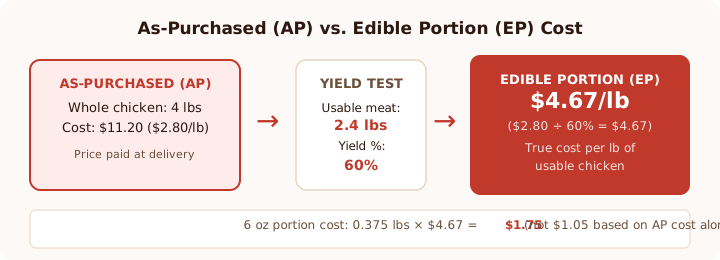
Example: Whole chicken
- AP cost: $2.80/lb
- You buy a 4-lb whole chicken: $11.20
- After butchering: 2.4 lbs of usable meat (bones, skin, fat removed)
- Yield %: 2.4 ÷ 4.0 = 60%
- EP cost: $2.80 ÷ 0.60 = $4.67/lb of usable meat
If your recipe uses 6 oz (0.375 lbs) of chicken, the ingredient cost is 0.375 × $4.67 = $1.75, not 0.375 × $2.80 = $1.05.
That $0.70 difference per portion might seem small, but across 200 covers a week it's $140/week, or $7,280/year of food cost you're not accounting for.
Use our recipe cost calculator to run these numbers. Enter the EP cost (post-yield cost) as your ingredient cost, or use the waste factor field to account for yield automatically.
Yield Percentages for Common Ingredients
Memorizing yield percentages for your most-used ingredients is one of the most valuable skills in kitchen management. Here are standard yields as a starting reference, your actual yields may vary based on supplier quality and kitchen skill:
Proteins:
| Ingredient | Typical Yield % | Notes |
|---|---|---|
| Whole chicken | 58–65% | Boneless, skinless yield |
| Chicken breast (bone-in) | 72–78% | After boning |
| Chicken thigh (bone-in) | 68–75% | After boning |
| Whole salmon | 45–55% | Head, bones, skin removed |
| Salmon fillet | 85–92% | Pin bones and trim only |
| Ground beef (80/20) | 70–78% | After cooking moisture loss |
| Pork shoulder (bone-in) | 65–72% | After bone and fat cap |
| Shrimp (shell-on, 16/20) | 65–70% | After shell and tail removal |
Produce:
| Ingredient | Typical Yield % | Notes |
|---|---|---|
| Head lettuce (iceberg) | 72–80% | Outer leaves and core removed |
| Spinach (fresh bunch) | 78–85% | Stems removed |
| Broccoli (crown) | 68–75% | Stems removed, florets only |
| Carrots (whole) | 82–88% | Peel, tips, tops |
| Onions (yellow, whole) | 85–90% | Skin and ends |
| Bell peppers | 80–85% | Seeds and stem |
| Tomatoes (roma) | 88–92% | Core only |
| Potatoes (russet) | 80–85% | Peel and eyes |
| Avocado | 65–75% | Skin and pit |
These are guidelines, not guarantees. Run your own yield tests on your most expensive ingredients, even one yield test per week over a month gives you kitchen-specific data far more accurate than industry averages.
How to Run a Yield Test
A yield test takes 10 minutes and can save thousands of dollars in food cost calculation errors.
You need: A kitchen scale, the ingredient, and a notepad.
1. Weigh the ingredient before any processing. Record this as AP weight.
2. Process the ingredient as you would for service (peel, trim, butcher, etc.).
3. Weigh the usable product. Record as EP weight.
4. Calculate yield %: EP weight ÷ AP weight × 100.
5. Calculate EP cost: AP cost per lb ÷ Yield % = EP cost per lb.
Run this test 3–5 times with different deliveries to account for supplier variability. Average the results.
Do this for:
- Your 5 highest-cost ingredients by monthly spend
- Any ingredient with high variability (whole fish, leafy greens, fresh produce)
- Any new ingredient you're adding to the menu
Once you have your yield percentages, enter ingredient costs in our food cost calculator and use the waste factor field to automatically convert AP cost to EP cost.
Building a Recipe Cost Card
A recipe cost card is a standardized document that lists every ingredient in a recipe with its EP cost, quantity used, and unit cost. It's the foundation of consistent food cost management.
Example cost card: Classic Caesar Salad (1 serving)
| Ingredient | AP Cost | Yield % | EP Cost/lb | Qty Used | Item Cost |
|---|---|---|---|---|---|
| Romaine lettuce | $1.80/lb | 78% | $2.31/lb | 4 oz (0.25 lb) | $0.58 |
| Parmesan (block) | $8.40/lb | 95% | $8.84/lb | 0.5 oz (0.031 lb) | $0.27 |
| Caesar dressing | $3.20/32 oz | 100% | $0.10/oz | 1.5 oz | $0.15 |
| Croutons | $2.80/lb | 100% | $2.80/lb | 0.75 oz (0.047 lb) | $0.13 |
| Lemon (for squeeze) | $0.55/each | 40% juice yield | - | 0.25 oz juice | $0.04 |
| Anchovies (optional) | $4.50/tin | 90% | $5.00/lb | 0.3 oz | $0.09 |
Total ingredient cost: $1.26
Apply a 5% waste/seasoning factor: $1.26 × 1.05 = $1.32 per serving
At a $14 menu price: Food cost % = $1.32 ÷ $14.00 × 100 = 9.4%, an excellent margin for a salad.
Bulk Ingredient Costing
For ingredients you buy in large containers (gallons of oil, 50-lb flour bags, bulk spices), calculate a per-unit price first:
Per-ounce cost: Container price ÷ ounces per container = cost per oz
Then multiply by the ounces or grams your recipe uses.
Example:
- 1-gallon (128 oz) olive oil: $18.40
- Cost per oz: $18.40 ÷ 128 = $0.144/oz
- Recipe uses 2 oz: 2 × $0.144 = $0.29
This is the correct ingredient cost to enter, not $18.40. Never enter a package price unless the recipe uses the entire package.
Using the Recipe Cost Calculator for Ingredient Costing
Our recipe cost calculator handles up to 8 ingredient line items, which covers most dishes. For dishes with more ingredients, cost the sub-components first:
1. Cost your house sauce as a separate recipe, get cost per ounce
2. Enter that per-serving sauce cost as one ingredient line item in the main recipe
This modular approach lets you update sauce costs in one place and have them cascade to every dish that uses it.
Enter your post-yield costs (EP costs) for maximum accuracy, or enter AP costs and use the waste factor to apply a blended yield correction. The waste factor approach works well when you have a mix of high-yield and low-yield ingredients and don't want to calculate individual EP costs.
The Real Value of Accurate Costing
Accurate ingredient costing isn't busywork. It's the difference between knowing you're making money and hoping you're making money. A restaurant that guesses at recipe costs is essentially running with its eyes closed.
Once your cost cards are accurate, you can:
- Price new dishes confidently before launch
- Identify underperforming items that drag your food cost up
- Negotiate with suppliers from a position of knowledge
- Train your team on exact portion sizes with the financial stakes visible
Start with your top 10 selling dishes. Run yield tests, build cost cards, enter them into the food cost calculator. Get those right first, then expand to your full menu. Precision on your high-runners has the biggest impact on your overall food cost percentage.
Industry References
- Culinary Institute of America, Recipe Costing and Yield Testing (ciachef.edu)
- National Restaurant Association Educational Foundation, ManageFirst Food Cost & Kitchen Management
- Food Service Management Professional, Ingredient Yield Standards Reference Guide
Ready to cost your recipes?
Use our free calculator to get total cost, food cost %, and suggested menu price in seconds.
Calculate Recipe Cost (Free) →