Batch Cooking Cost Savings: Meal Prep Math for Home Cooks
Batch cooking can cut your weekly food spend by 30-40%. Learn how to calculate cost per meal, plan your prep sessions, and make the numbers work for any household size.
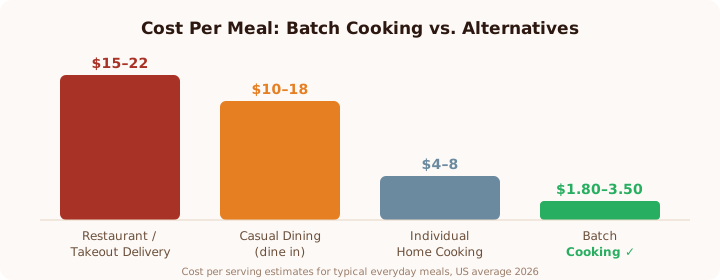
Cooking one portion at a time is the most expensive way to feed yourself. Every time you cook a single chicken breast or boil a single serving of pasta, you're paying full price for energy, prep time, and the portion of ingredients that get wasted in partial-use packaging.
Batch cooking flips that equation. A 3-hour Sunday prep session for a family of four can produce 20–25 meals at a cost of $1.80–$3.50 per serving, compared to $4–8 for individual cooking or $15–22 for restaurant/takeout meals.
The math is compelling, but only if you plan it correctly.
The Core Math: Cost Per Meal
Before you prep anything, know what you're aiming for. Use our recipe cost calculator to find your cost per serving for each recipe.
Example: Big batch lentil soup
- Red lentils (1 lb): $1.80
- Canned diced tomatoes (2 cans): $2.20
- Onion (1 large): $0.55
- Garlic (4 cloves): $0.25
- Carrots (3 medium): $0.60
- Cumin, coriander, turmeric, olive oil: $0.45
- Vegetable stock (4 cups): $0.80
Total recipe cost: $6.65 for 8 generous servings = $0.83 per serving
That $0.83/serving is what you'd enter into a meal plan as your lunch cost for 8 days. It's not glamorous, but paired with a $0.30 piece of crusty bread and a $0.25 side salad, you have a filling, nutritious lunch for $1.38.
Compare that to a $14 sandwich at a deli or a $12 bowl of restaurant soup. The batch-cooked lunch saves you $12.62 per meal. If you eat lunch out 5 days a week versus meal prepping, that's $63/week, $3,276/year in food savings, from one recipe.
Choosing Recipes That Batch Well
Not all recipes benefit equally from batch cooking. The best batch recipes share these traits:
High yield-to-effort ratio: Recipes that make 6–10 servings with less than 45 minutes of hands-on time.
Freeze or refrigerate well: Soups, stews, grains, roasted proteins, and casseroles all hold quality for 4–7 days refrigerated or 2–3 months frozen. Fresh salads, delicate fish, and crispy foods don't batch well.
Ingredient overlap: Plan batches where one ingredient appears in multiple recipes. If you roast a tray of sweet potatoes, some go into lunch bowls, some into a hash, some into soup. You process once, use everywhere.
Good recipes for batch cooking:
- Soups and stews (lentil, minestrone, chili, chicken noodle)
- Grain bases (rice, quinoa, farro, barley, cook 4–6 cups at once)
- Roasted proteins (sheet pan chicken thighs, baked salmon fillets)
- Hard-boiled eggs (make 12 at a time)
- Overnight oats or baked oatmeal (makes 5–6 servings)
- Sheet pan roasted vegetables (caramelize in bulk, add to anything)
- Dried beans (a 1-lb bag cooked from dry makes 6 cups, way cheaper than canned)
Planning a Week of Batch Meals
The key to batch cooking efficiency is a plan, not improvisation.
Step 1: Decide your meals for the week
Write out what you'll eat for the week, breakfast, lunch, and dinner. Don't plan every meal from scratch; use variations and leftovers strategically.
Example week (2 people):
- Breakfasts: Overnight oats (5×), eggs and toast (2×)
- Lunches: Grain bowls with roasted vegetables and chicken (4×), lentil soup (3×)
- Dinners: Sheet pan salmon (2×), chicken stir-fry (2×), pasta (1×), salmon leftovers (1×), batch soup + salad (1×)
Step 2: Cost each recipe
Use the recipe cost calculator for each dish. Enter ingredient costs and servings to get cost-per-serving for each item. Then total up weekly food cost.
Example weekly costs (2 people):
- Overnight oats (10 servings): $5.40 → $0.54/serving
- Hard-boiled eggs (14 servings): $3.50 → $0.25/serving
- Lentil soup (6 servings): $5.00 → $0.83/serving
- Grain bowls (8 servings): $14.40 → $1.80/serving
- Sheet pan salmon (4 servings): $20.00 → $5.00/serving
- Chicken stir-fry (4 servings): $14.00 → $3.50/serving
- Pasta dinner (2 servings): $4.80 → $2.40/serving
Total food spend: ~$67/week for 2 people = $33.50/person/week
The national average household food spend is $70–$90 per person per week including dining out. Batch cooking can cut your per-person weekly food cost by 50–60%.
Step 3: Build a shopping list by ingredient
After costing your recipes, consolidate ingredients. Buying 2 lbs of chicken for the stir-fry and 4 lbs for the grain bowls means you're buying 6 lbs total, which might qualify for a better per-pound price at the butcher counter. Cross-reference ingredient lists before shopping.
The Batch Cooking Session
A well-planned prep session runs on a schedule, not a whim. Here's how to structure 3 hours:
0:00–0:20, Mise en place
Wash, chop, and organize everything before you turn on a single burner. Dice all your onions at once, peel all your carrots, mince all your garlic. Batch prep is 10× more efficient when you process ingredients in large batches.
0:20–1:00, Oven items (longest cook time)
Get your sheet pans in the oven first: roasted chicken thighs, roasted vegetables, baked salmon. These take 25–45 minutes and run unattended.
1:00–2:00, Stovetop items (require attention)
While the oven runs, cook your grains (rice, quinoa), your stew or soup, and your stovetop proteins. Start the longest-cooking item (dried beans, braise) first.
2:00–2:45, Assembly and portioning
Portion finished items into containers. Label everything with name, date made, and number of servings. This step is essential, unlabeled containers cause waste when you don't remember what's inside or how old it is.
2:45–3:00, Cool and refrigerate/freeze
Let hot items come to room temperature before refrigerating (don't put hot food in a cold fridge, it raises the internal temp and risks other food). Portion meals that will be frozen now, before refrigerating.
Maximizing Savings: Buying in Bulk
Batch cooking pairs with bulk buying to maximize savings. Ingredients that store well and you use consistently should be bought in larger quantities:
- Dried beans and lentils: 10× cheaper than canned per serving; stores for 2+ years
- Whole grains (rice, oats, quinoa): Buy the 10-lb bag; stores 18+ months
- Olive oil and cooking oils: Buy the large tin; better per-ounce price
- Canned tomatoes, broth: Case pricing is significantly cheaper per unit
- Frozen vegetables: Often cheaper than fresh and equally nutritious for cooking applications
Calculate the per-serving cost for bulk items using our food cost calculator to verify the math actually works out, sometimes "bulk" pricing isn't as good a deal as the packaging suggests.
What About the Time Investment?
The common objection: "I don't have 3 hours on Sunday."
Consider the math: 3 hours of prep on Sunday eliminates 20–25 minutes of daily cooking time, 5–7 nights per week. That's 100–175 minutes of daily cooking eliminated. Over a week, you net save 40–115 minutes of total kitchen time.
You also eliminate daily mental load, "what should I make tonight?" and multiple grocery trips. Research on decision fatigue suggests this cognitive savings has real value.
If 3 hours is too much, start with one batch item. Make a big pot of soup. Cook a full sheet pan of chicken thighs. Prep a double batch of overnight oats. Even one batch item saves time and money.
Comparing Batch Cooking to Restaurant Costs
Our full DIY vs. restaurant cost comparison breaks down this math in detail. In short: the average American spends $90–$120/month dining out for lunch alone. Replacing 4 lunches per week with batch-cooked meals saves approximately $240–$360/month, $2,880–$4,320/year.
The recipe cost calculator makes it easy to see exactly what your homemade version of any dish costs. Try costing your most-ordered takeout meal at home. The number is usually surprising.
Studies and Data Cited
- USDA Economic Research Service, Food Expenditure Tables (ers.usda.gov)
- Bureau of Labor Statistics, Consumer Expenditure Survey (bls.gov)
- National Restaurant Association, Dining Habits Report (restaurant.org)
Ready to cost your recipes?
Use our free calculator to get total cost, food cost %, and suggested menu price in seconds.
Calculate Recipe Cost (Free) →