Food Waste in Restaurants: The Real Cost and How to Cut It
The average restaurant wastes 4-10% of purchased food. Learn how to track, measure, and reduce food waste to recover thousands of dollars in margin each month.
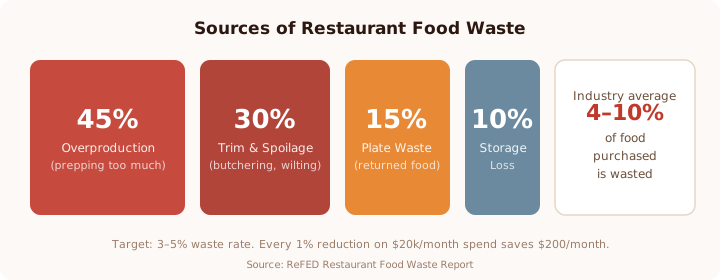
The average restaurant throws away 4–10% of the food it buys. That sounds abstract until you attach a dollar amount to it. On $25,000 in monthly food purchases, a 7% waste rate means $1,750 straight to the trash, every month, every year.
Waste is the silent killer of restaurant margins because it's invisible in your P&L until you go looking for it. It doesn't show up as a line item; it just inflates your food cost percentage without an obvious explanation.
Where Restaurant Food Waste Actually Comes From
Understanding where waste originates is the first step to cutting it. The four main categories:
Overproduction (40–50% of total waste)
Prepping more food than you sell on a given shift. A slow Tuesday following a prep schedule designed for a busy Saturday creates massive overproduction. Once prepped food crosses its hold time, it goes in the bin.
Trim and butchering waste (25–35%)
Every whole chicken has bones, skin, and fat. Every block of salmon has pin bones, belly fat, and uneven end cuts. Every block of parmesan has a rind. This is unavoidable waste, but its extent varies hugely based on skill, training, and how you buy proteins (whole vs. portions vs. pre-cut).
Spoilage (15–20%)
Produce wilts. Dairy sours. Fish doesn't keep. Poor FIFO (first in, first out) rotation, incorrect storage temperatures, or over-ordering all accelerate spoilage. A single forgotten case of lettuce in the back of the walk-in can cost $40–$80 and contaminate other produce.
Plate waste (5–10%)
Food that comes back on plates from diners. While some plate waste is inevitable, excessive plate waste signals portion sizes are too large, food quality is disappointing, or you're serving dishes guests aren't actually hungry for.
How to Measure Your Waste
You can't reduce what you don't measure. Here's a simple system:
1. Track daily with a waste log
Put a notebook or clipboard in the kitchen. Every time food is thrown away, log it: what item, how much (weight or unit count), and why (spoiled, overproduction, trim, dropped, expired). Do this for 2 weeks to establish a baseline.
2. Calculate waste percentage by category
After 2 weeks: Total waste value (in dollars) ÷ Total food purchases = Waste %.
If you bought $6,000 in food and logged $480 in waste, that's 8% food waste. The target for a well-run kitchen is 3–5%.
3. Compare theoretical vs. actual food cost
Your POS knows what you sold. Multiply units sold by recipe cost to get your theoretical food cost, what you should have spent based on sales. Compare that to actual food cost (beginning inventory + purchases – ending inventory).
If theoretical food cost is 28% but actual is 33%, the 5% gap represents waste, theft, or portioning errors. Each 1% on $30,000 monthly food revenue is $300. Five percent is $1,500, gone.
Use our recipe cost calculator to establish accurate theoretical costs for every dish, which is the foundation of this analysis.
7 Proven Waste Reduction Strategies
1. Demand-based prep schedules
Stop prepping based on intuition. Use your POS data to build a 4-week sales forecast for each menu item by day of week. Prep to 90% of forecasted demand, then batch small as needed. You'll occasionally run 86 on an item, that's fine. Running out is better than wasting $300 in prepped salmon.
2. Enforce FIFO religiously
First In, First Out means the oldest product is always used first. This requires labeling everything with a date received, and training every team member to rotate stock consistently. A walk-in cooler where new deliveries are stacked in front of old product is a spoilage machine.
3. Cross-use every protein across multiple dishes
Every protein you buy should appear in at least 2–3 dishes at different price points. Chicken thighs trim into a teriyaki bowl; chicken bones become stock for your soup. Salmon trim (belly and pin bone area) becomes a salmon tartare or fish tacos. Beef fat becomes tallow for frying. Cross-utilization is how nose-to-tail cooking reduces protein waste to near zero. Our seasonal menu planning guide has a full cross-utilization matrix for common proteins.
4. Smaller batch, more frequent cooking
Chefs naturally cook in large batches for efficiency. But a large batch that sits for 4 hours may need to be discarded. Smaller batches cooked more frequently keeps food fresher and reduces overproduction waste. This is especially true for fried foods, sauces, and anything with a short hold time.
5. Use trim and off-cuts in staff meals
Staff meals are a controllable expense, but they can also be a waste recovery channel. Use today's trim, carrot tops, vegetable scraps, pasta that broke during cooking, as staff meal ingredients rather than buying additional food. A well-run staff meal program can save $15–$30 per day in food cost while improving team morale.
6. Conduct regular walk-in audits
Walk your cooler and dry storage every morning. Look for items approaching expiration, product that's been improperly covered or stored, and anything that shouldn't be there (personal food, mystery containers with no label or date). A 10-minute walk-in audit every morning prevents the $80 case of wilted produce from becoming a spoilage write-off.
7. Right-size your ordering
Over-ordering is the root cause of most spoilage waste. Set par levels for every ingredient based on your sales forecast, delivery schedule, and maximum shelf life. If you receive delivery on Monday and Wednesday, your Monday order needs to carry you through Wednesday, no more, unless an item has a 5+ day shelf life.
The Waste Factor in Your Recipe Costs
When you run food through our food cost calculator, the waste factor field accounts for unavoidable trim and cooking loss. Here are realistic waste factors by ingredient type:
| Ingredient | Waste Factor |
|---|---|
| Whole chicken | 35–42% (bones, skin) |
| Chicken breast (boneless) | 8–12% (trim, cooking moisture) |
| Whole salmon | 45–55% (head, bones, skin) |
| Salmon fillet | 10–15% (pin bones, trim, cooking) |
| Ground beef | 20–30% (cooking moisture loss) |
| Leafy greens (head) | 20–30% (outer leaves, stems) |
| Carrots (whole) | 12–18% (tops, tips, peel) |
| Onions | 8–15% (skin, ends) |
| Tomatoes | 8–12% (core, blemishes) |
| Potatoes | 15–20% (peel, eyes, trim) |
These are starting points, track your actual yields for a month to get kitchen-specific numbers. A skilled butcher might yield 70% from a whole chicken; a less experienced prep cook might yield 58%.
What This Means for Your Bottom Line
Let's use a concrete example. A 50-seat casual restaurant doing $45,000 per month in food revenue. Current food waste is 8% of $20,000 in monthly food purchases = $1,600/month in waste.
Implementing the strategies above and getting waste down to 4% reduces the waste cost to $800/month, a $800/month recovery in margin, or $9,600/year. That's real money that flows straight to profit without a single additional customer walking through your door.
Track your waste for 30 days with a simple log. Calculate your waste percentage. Then pick two or three of the strategies above and implement them consistently. Measure again in 30 days.
Small, consistent improvements in waste management compound. A kitchen that gets from 8% to 5% food waste over six months has recovered thousands of dollars, and built habits that keep it there.
Studies Referenced
- ReFED, Restaurant Food Waste Report 2024 (refed.org)
- National Restaurant Association, Sustainability and Waste Reduction (restaurant.org)
- USDA Food Loss and Waste Report (usda.gov)
Ready to cost your recipes?
Use our free calculator to get total cost, food cost %, and suggested menu price in seconds.
Calculate Recipe Cost (Free) →