How to Price Menu Items: The Food Cost Formula
Learn the food cost formula restaurants use to price menu items profitably. Step-by-step guide with real examples and a 30% food cost target breakdown.
Pricing a menu item wrong is one of the fastest ways to bleed a restaurant dry. Set prices too low and you're working hard for nothing. Too high and customers leave, or worse, they stay but never come back.
The good news: there's a proven formula that professional kitchens have used for decades. It's not complicated, but it requires accurate numbers.
The Core Formula: Divide by 0.30
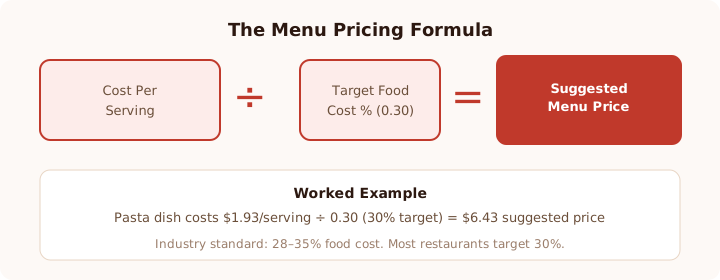
The simplest pricing formula in food service is:
Menu Price = Cost Per Serving ÷ Target Food Cost %
If you're targeting 30% food cost (the industry standard), divide your cost per serving by 0.30. A dish that costs $3.20 per serving has a suggested price of $3.20 ÷ 0.30 = $10.67. You'd likely round to $10.99 or $10.95.
That's your starting point, not your final answer. The formula gives you the floor. Market conditions, competition, and your concept determine where the ceiling sits.
To get an accurate cost per serving, use our recipe cost calculator to total your ingredient costs and divide by servings. Don't guess at this number; a $0.50 error per dish multiplied across 200 covers a day is a $100 daily margin miss.
Why 30% and Not Some Other Number?
The 30% food cost target comes from decades of restaurant profitability research. At 30% food cost, your revenue splits roughly like this:
- 30%, food cost
- 30–35%, labor cost
- 20–25%, overhead (rent, utilities, insurance, supplies)
- 5–10%, profit
That leaves a thin but workable margin. If your food cost rises to 38%, something else has to shrink, usually profit first, then labor quality suffers, then the restaurant closes.
Different restaurant types target different food cost percentages:
| Concept | Typical Food Cost |
|---|---|
| Fast food / QSR | 25–28% |
| Fast casual | 27–30% |
| Casual dining | 28–32% |
| Fine dining | 30–38% |
| Bar / Gastropub | 20–28% (food), 18–24% (beverage) |
Fine dining can run higher food costs because the dining experience, service, ambiance, presentation, commands higher prices. A $48 entrée with a 36% food cost still generates strong contribution margin.
Step-by-Step: Pricing a New Dish
Here's how to price a new menu item from scratch.
Step 1: Cost every ingredient by portion used
Pull out your recipe and list every ingredient. For each one, calculate the cost of the exact amount used, not the full package.
Example: Grilled salmon with roasted vegetables and lemon butter.
- Atlantic salmon fillet (6 oz): $4.20
- Baby potatoes (5 oz): $0.55
- Asparagus (3 oz): $0.75
- Butter (1 oz): $0.18
- Lemon: $0.35
- Olive oil (0.5 oz): $0.12
- Salt, pepper, herbs: $0.10 (estimated)
Raw ingredient total: $6.25
Step 2: Apply a waste factor
Fresh fish loses 5–10% in trimming and cooking moisture loss. Vegetables lose 10–20% in trim and roasting. A blended waste factor of 10% is conservative for this dish.
Waste cost: $6.25 × 0.10 = $0.63
Total cost per serving: $6.88
You can run this automatically using the food cost calculator, just enter each ingredient cost and set the waste percentage.
Step 3: Apply the pricing formula
At 30% target: $6.88 ÷ 0.30 = $22.93
At 32% target (more room for a premium dish): $6.88 ÷ 0.32 = $21.50
You'd likely price this at $23 or $24 depending on your market. If comparable salmon dishes at nearby restaurants run $28–$32, you have room to price higher and still be competitive.
Step 4: Check your competition
The formula gives you a minimum viable price. Your market sets the maximum. Before finalizing, check:
- What do 3–5 comparable restaurants charge for a similar dish?
- What's the price sensitivity of your target customer?
- Does this dish anchor your menu at a high price point, making other items look like better value?
A $38 price on a luxury seafood entrée makes a $22 pasta look like a deal, that's menu engineering in action. Check our menu engineering guide for how to build that dynamic intentionally.
Psychological Pricing: The Details Matter
Once you have a price range, use these tactics to optimize:
End prices in 9 or 5: $14.99 consistently outperforms $15.00 in consumer research. The left-digit effect makes $14 read cheaper than $15 even when the difference is a penny.
Avoid dollar signs where possible: Remove the "$" symbol on your printed menu. Research by Cornell University shows menus without dollar signs generate higher average checks, the symbol primes cost-consciousness.
Use precise prices sparingly: $11.27 looks like an accounting error and draws attention to cost. Round to natural price points ($11, $11.50, $11.99) unless you're running a deliberately value-focused concept.
Create price anchors: Include 1–2 high-price items on your menu even if you don't expect to sell many. A $55 tasting plate makes a $28 entrée feel reasonable by comparison.
Common Pricing Mistakes
Pricing based on what feels right: "We'll charge $15 for the burger because that's what people expect to pay" is how restaurants end up with a 45% food cost on their best-selling item.
Ignoring waste: If you don't account for trimming, spoilage, and cooking loss, your real food cost is consistently higher than your modeled cost. A 10% waste factor on proteins can add $0.30–$0.80 per plate.
Not updating prices: Ingredient costs change quarterly. A salmon dish priced in January might have a 34% food cost by June if Atlantic salmon prices spike. Set a calendar reminder to review your top 10 items every quarter. Our seasonal menu planning guide has a full framework for managing this.
Treating every dish equally: Your menu is a portfolio. Some dishes subsidize others. A $2.50 food cost pasta dish running at 18% food cost can carry a 38% food cost short rib that brings in high-spending customers. Track the blended food cost across your whole menu, not just individual items.
What About Catering and Events?
Catering pricing follows the same food cost formula, but the target percentage is lower, typically 20–28%, because the higher volume of an event spreads your prep labor more efficiently. However, you need to add line items for:
- Event labor (service staff, bartenders, setup crew)
- Transportation and delivery
- Equipment rental
- Administrative overhead
For a full breakdown of catering cost structure, read our catering recipe cost guide. The recipe cost calculator works for catering too, cost each menu item, then add your other cost lines to arrive at a per-person event price.
Putting It All Together
Menu pricing isn't art, it's math with a market filter on top. The formula is simple: cost per serving divided by your target food cost percentage. The precision comes from costing every ingredient accurately, accounting for waste, and revisiting prices when ingredient costs change.
Start with the recipe cost calculator to get accurate per-serving costs on every dish. Then apply the 30% rule as your floor, check your market as your ceiling, and use psychological pricing to optimize within that range. Do that consistently and you'll have a menu that works financially, not just culinarily.
Cited Research
- National Restaurant Association, Menu Pricing Best Practices (restaurant.org)
- Cornell University School of Hotel Administration, Menu Design Research
- Culinary Institute of America, Food Cost Management (ciachef.edu)
Ready to cost your recipes?
Use our free calculator to get total cost, food cost %, and suggested menu price in seconds.
Calculate Recipe Cost (Free) →