Food Cost Percentage: What It Is and How to Hit 30%
Food cost percentage is the ratio of ingredient cost to menu price. Learn what the target is, how to calculate it, and tactics to reduce it without cutting quality.
If you run a restaurant and you're not tracking your food cost percentage weekly, you're flying blind. This single number tells you more about your kitchen's financial health than almost any other metric.
Food cost percentage is the ratio of your ingredient costs to your revenue. A burger that costs $3.00 in ingredients and sells for $10.00 has a 30% food cost. That's the target most restaurants aim for, and it's not arbitrary.
How to Calculate Food Cost Percentage
The formula:
Food Cost % = (Cost Per Serving ÷ Menu Price) × 100
Or, for your entire operation over a period:
Food Cost % = (Beginning Inventory + Purchases – Ending Inventory) ÷ Total Food Revenue × 100
The first formula tells you where a single dish stands. The second tells you how your whole kitchen is performing. You need both.
Use our recipe cost calculator to get accurate cost-per-serving figures for individual dishes. For the period-based calculation, you'll need your inventory records from your POS or accounting system.
What's a Good Food Cost Percentage?
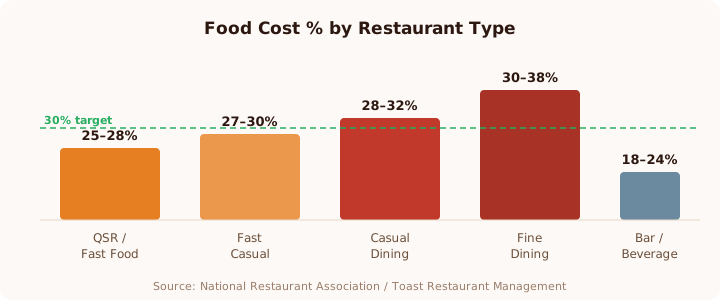
The industry standard target is 28–35%, with 30% as the most common benchmark. But that range varies by restaurant type:
Quick service and fast food (25–28%): Lower because of standardized recipes, minimal labor in food prep, and high volume that allows bulk purchasing power. McDonald's operates closer to 30%, but local pizza shops often hit 25–27% by controlling portion sizes tightly.
Fast casual (27–30%): Chipotle publicly reports food costs around 30–32%. The build-your-own model creates some waste variability but enables price points that support the cost structure.
Casual dining (28–32%): The most common full-service restaurant category. Olive Garden parent company Darden Restaurants targets 28–30%. Your neighborhood bar and grill should aim for the same range.
Fine dining (30–38%): Premium proteins, imported ingredients, and elaborate prep justify higher food costs because menu prices are also higher. A $60 halibut dish at 36% food cost still generates more contribution margin than a $14 pasta at 22% food cost if the halibut drives covers.
Bars and beverages (18–24%): Alcohol has dramatically lower cost ratios than food. A $12 cocktail might have $1.80 in ingredients, a 15% beverage cost. This is why bars make money even when their kitchen food cost runs high.
Why 30% Is the Magic Number
The 30% food cost target isn't industry mythology, it reflects how restaurant economics actually work. Most restaurants need to allocate:
- 30–35% to labor (wages, benefits, payroll taxes)
- 20–25% to overhead (rent, utilities, insurance, POS, supplies, marketing)
- 5–10% to profit
Add those up and you get 85–95% of revenue allocated before food. That means food must stay at or below 30% to leave a viable profit margin. If food cost rises to 38%, something has to give, and it's usually profits first, then staff quality, then the business itself.
Prime cost, food cost plus labor cost, is an even sharper metric. Prime cost should stay at or below 60–65% of revenue. If your food cost is 30% and labor is 35%, you're at 65% prime cost with 35% left for overhead and profit. That's workable. If prime cost hits 72%, you're almost certainly losing money.
8 Tactics to Reduce Food Cost Without Cutting Quality
1. Portion control is the fastest win
Every ounce of inconsistency in portioning is a direct hit to your food cost. If your standard chicken breast portion is 6 oz and cooks are plating 7 oz, you're losing 16% on every chicken dish. Install a scale at the protein station. It's a $30 investment that can recover thousands of dollars monthly. Read our ingredient cost breakdown guide for how to build portion cost cards for every dish.
2. Reduce waste with mise en place discipline
Mise en place, "everything in its place", is the French culinary concept of prepping only what you'll use. Restaurants that prep by feel end up throwing out $150+ in food on a slow Wednesday night because they prepped for a busy Saturday. Our restaurant food waste guide covers how to build forecasting systems that reduce this significantly.
3. Cross-use ingredients across multiple dishes
Every ingredient on your menu should appear in at least 2–3 dishes. If you're buying whole chickens, the breast goes to an entrée, the thighs to a sandwich or taco, the carcass to stock. An ingredient that only appears in one dish creates waste risk every time that dish underperforms.
4. Engineer your menu around margins
Menu engineering categorizes every dish by profitability and popularity. High-profit, high-popularity dishes (Stars) should be prominent on your menu. High-profit, low-popularity dishes (Puzzles) need better placement or description work. Low-profit, high-popularity dishes (Plowhorses) should be repriced or reformulated. Dogs (low profit, low popularity) should be cut. See our full menu engineering guide.
5. Negotiate with multiple suppliers
If you're buying all your proteins from one supplier, you're leaving money on the table. Get quotes from 2–3 suppliers for your top 5 ingredients quarterly. Even a $0.15/lb reduction on chicken across 400 lbs monthly is $60/month, $720/year, from one phone call.
6. Track yield percentages by ingredient
Yield percentage is how much of an ingredient you have after butchering, peeling, or trimming. A whole chicken may yield 60% usable meat. Russet potatoes yield 85% after peeling. If you're buying 10 lbs of carrots and getting 7.5 lbs of usable product, your effective cost is the purchase price ÷ 0.75. Use the recipe cost calculator with a waste factor to account for this automatically.
7. Price seasonal ingredients as "market price"
For ingredients with highly volatile pricing (fresh fish, certain produce), consider listing them on a chalkboard or insert as "MP", market price. This protects your food cost when prices spike without requiring constant menu reprints. Train servers to quote the current price confidently and upsell the quality story.
8. Run a weekly variance report
Your theoretical food cost (what you should have spent based on sales) versus your actual food cost (what you actually spent on food) reveals where product is going. A consistent 3–4% variance between theoretical and actual food cost means roughly $3,000–$4,000 of product disappearing every $100,000 in revenue. That's theft, waste, or portioning errors, all fixable once you know where to look.
How to Track Food Cost Week-to-Week
Weekly food cost tracking requires three inputs:
1. Beginning inventory value (your inventory count at week start)
2. Purchases received during the week (supplier invoices)
3. Ending inventory value (count at week end)
Formula: (Beginning Inventory + Purchases – Ending Inventory) ÷ Weekly Food Revenue = Weekly Food Cost %
Do this every week, same day, same time. Inconsistency in timing creates false readings, a Thursday count in a week with a Friday delivery skews the numbers badly.
Most POS systems (Toast, Square for Restaurants, Lightspeed) can generate these reports automatically if you have your recipe costs entered. If you're still tracking manually, a spreadsheet with those three fields is enough to get started.
What This Means For Your Restaurant
Food cost percentage is the heartbeat of your restaurant's financial health. Keep it in the 28–32% range, track it weekly, and investigate any spike above 33% immediately. Use our recipe cost calculator to establish accurate baseline costs for every dish on your menu, that's the foundation everything else is built on.
References
- National Restaurant Association, Restaurant Industry Report 2025 (restaurant.org)
- Culinary Institute of America, Food Cost Management Module (ciachef.edu)
- Toast Restaurant Management, State of the Restaurant Industry (pos.toasttab.com)
Ready to cost your recipes?
Use our free calculator to get total cost, food cost %, and suggested menu price in seconds.
Calculate Recipe Cost (Free) →